
 Translate
Search
-
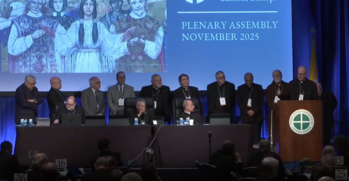 November 18, 2025On Tuesday November 11, 2025, Cardinal Timothy Dolan, the Chairman of the Board of TPMS-USA, spoke to all of the bishops of the USCCB about the Missions for the first time the TPMS-USA has addressed the whole body of US bishops in at least a quarter of a century.
Below is the text of his presentation: with the video available at https://drive.google.com/file/d/1QuLdd2qQbIZ3jYsqk1q3eAsBvOIAN-YP/viewJoining me on the dais are the bishop members of the board of The Pontifical Mission Societies — you see them coming up now, I’m deeply grateful to them — as well as the extraordinarily committed and knowledgeable lay and diaconal members, Stephen Auth, Barry Jackson, John McManus and Deacon Frank Kurre. I wanted you to see them all.My brother bishops and the Board Members are particularly grateful to the energetic involvement of our Apostolic Nuncio, Cardinal Christophe Pierre, who is a very active and engaged member of the Board.You all know what we mean by The Pontifical Mission Societies. We mean four things. The Society for the Propagation of the Faith; the Society of St. Peter the Apostle, which supports almost all of the priests from the developing world; the Holy Childhood, or Missionary Childhood Association, in which children support children in the missions throughout the world; and the Pontifical Missionary Union, which promotes the missionary spirituality and formation of the people of God.I’m eager to make sure that you know our new National Director, Monsignor Roger Landry, a priest of the Diocese of Fall River — thank you, Bishop Da Cunha! — and appointed by the Holy See.I’m coming before you with gratitude and offering some words of encouragement that seem particularly appropriate for us now.Pope Leo is not just the first Pope from the United States, as proud as we are of that, but he’s the first pope since Saint Peter — get this — to have dedicated himself prior to the papacy to the missions, the missionary enterprise of the Church to the nations. He’s the first since St. Peter to have that claim. He therefore brings a compelling missionary perspective to his work as the 267th successor of the fisher of men from Galilee. His papacy is also the mature fruit of the Church in the United States, which gives us even greater reason than we always do to help the Pope succeed in his apostolic priorities as he seeks to form the “missionary church” he talked about from the St. Peter’s balcony on the night of his election.With regard to missionaries, we have fostered — think about it — the like of the young Father Robert Prevost. We have fostered the vocations of so many missionary men and women, through missionary orders, through the Maryknolls and the St. James Society, through various diocesan and archdiocesan missionary societies, and through adopting and staffing parishes particularly in Latin America and the Caribbean. It is a great legacy.Now the Catholic Church is also — and we don’t brag about this and are so grateful to our people — by far the most generous country in the world in terms of supporting the missions. The Church in the US pastored by you underwrites each year about 30-40 percent of all of the Church universal’s missionary endeavors. This is addition to all that’s given through the Missionary Cooperative Program in most dioceses as well as through the adoption of missionary dioceses and parishes at the local level.That having been said — alleluia! — let’s get a little more somber here. As the needs have grown, our support overall has not. Just 20 years ago, we raised nationally, in hard dollars, 63 million for the Society of the Propagation of the Faith. That was about three times what we raised last year to care for those dioceses that are too young, poor or persecuted to be self-sustaining. We’ve gone down by two-thirds what we were doing 20 years ago.We’re experts on what that’s been so. Mass attendance is down. Many are giving electronically and electronic services often don’t specify what the second collection is for, and people aren’t as generous to generic second collections. Some pastors, you know this, have made the decision — and most of us haven’t stopped them — not even to take up any second collections, whether mandated by canon law, decreed by the Holy Father, or decided by this Conference of Bishops, or even promulgated by their local bishop, and instead they might just tithe a certain percentage of the first collection. NO wonder the collection is down. And, brothers, that bothers us a lot.We also — and I’m talking for the bishops behind me on the board — we have also examined our conscience. And we wonder if one of the most important reasons why generosity has gone down is that maybe we have lost some of our focus on the missions, especially the mission ad gentes, what we used to call the foreign missions.It’s reasonable perhaps, as we have had to face various crises back home, like the reform of the Church after the horrors of 2002, or pastoral planning after major changes in Mass attendance or demography, or even soldiering through bankruptcy proceedings. Understandably, we have prioritized getting our own houses in order. And even when we have committed ourselves to mission over maintenance, often we’ve understood that in narrower parameters of the New Evangelization. How much time and energy have we dedicated to the mission ad gentes, the foreign missions. For us bishops in America, how can we not examine ourselves on the words of Jesus, “To whom much is given, more is to be expected?”Can I conclude by getting down to a few very specific items that would make a big difference in continuing and enhancing our historic generosity to the missions?First, Canon 791 requires each bishop to appoint a priest as diocesan mission director, and especially as director of The Pontifical Mission Societies. There are some dioceses that don’t yet have one. There are others who have given it to a priest with 15 other jobs who can’t adequately do this important work. Can we, your brothers, urge you to take similar care with this appointment as you do the other very important positions in your Diocese and set the director up so that he can really prioritize on your behalf.Second, the same canon likewise mandates that a collection be taken up for the missions. It’s the only collection mandated in canon law. In many other countries, including in the foreign missions, the poorest nations of the world, the World Mission Sunday collection is the only one taken that day, prioritizing the missions even over the obvious local needs of the own parish. Can I ask you to consider reinforcing that mandate within your dioceses? Even if pastors are not going to have a second collection for the missions as is expected in canon law, can you urge them to ensure that the first and only collection go entirely to the missions? I can’t think of a more pointed way to prioritize that evangelical mandate.Thirdly, in some dioceses there are accounting practices that are just unfair to the missions. For example, sometimes all the overhead of the Missions office is taken exclusively from the World Mission Sunday collection rather than a proportion taken from the Missionary Co-op or the funds raised for other missionary endeavors. In other places, where the mission director also runs the diocesan Catholic Relief Service office or other similar responsibilities, the salaries and experiences are all still taken from World Mission Sunday collection. This is simply not fair to the missions and it’s not respecting the intentio dantis (the intention of the donor).Lastly, can I urge you to consider using, my Lord, the great materials being produced by the Pontifical Mission Societies to promote missionary awareness and help with promoting World Mission Sunday? This year, thanks to the work of Monsignor Landry, Pope Leo became the first pope in history to record a one-minute video asking Catholics to help him help missionaries everywhere. Despite our best efforts, most parishes in the United States didn’t use this brief, direct, moving message from the first American pope, either before Mass, or in parish email blasts, on social media or through other obvious means. We bishops and lay and diaconal members of the Board can verify the effectiveness, color and compelling nature of the excellent materials coming from our national office under Monsignor Landry’s leadership, which can help us in getting the message out.I’ll wrap it up here. Next year, I don’t know if you know it or not, will be the 100th anniversary of Pope Pius XI’s decision to establish World Mission Sunday as a day for the whole Church to pray to the Harvest Master for missionaries and those to whom they are trying to bring the Gospel as well as to take up a collection to assist them in that saving work. I’d ask you, with this just now about 11 months away, to prepare for this important centenary and to do what it takes to do it well. Wouldn’t it be great if we set an all-time record and return to our pedigree of two decades ago? Wouldn’t it be sterling if we could really fulfill the hopes of those in the missions everywhere, in those places of first evangelization where the Church is too young and fragile, too poor or too persecuted to be self-sufficient? Wouldn’t it be great if we could do even more for the world than what the Pontifical Mission Societies did for us until 1908, when we stopped being considered a missionary country. It was the foreign mission societies that helped build our cathedrals, our parishes, our Churches, and helped educate our clergy. Wouldn’t it be great if we could now, in an era of self-sufficient for us, begin to pay back generously the way we were helped before? Wouldn’t it be great, brothers, now with an American pope, if we could help him much more care for all of the faithful in missionary lands?I just want to thank you for what you’ve done and encourage you to keep at it. And my brother bishops and all the members on the board join me in saying that. Thank you. Thank you very much.